Friends of Burgess Park have been exploring different sections of the park with Dom Leary, the parks officer and Ciaran, the head gardener. We have been making suggestions to improve the biodiversity of our part of London.

Walkabout One: Summer 2025
Pin Cushion walk. Leave an un-mown strip either side of the path encompassing the new trees. Alternate sides only to be mown once a year in spring. This would allow overwintering moth and butterfly larvae such as the Meadow Brown to feed on grass roots under the protection of the grass thatch and provide seed for birds throughout autumn and winter.
To be planted up with Scabious (Pin Cushion) and other UK native plug plants.
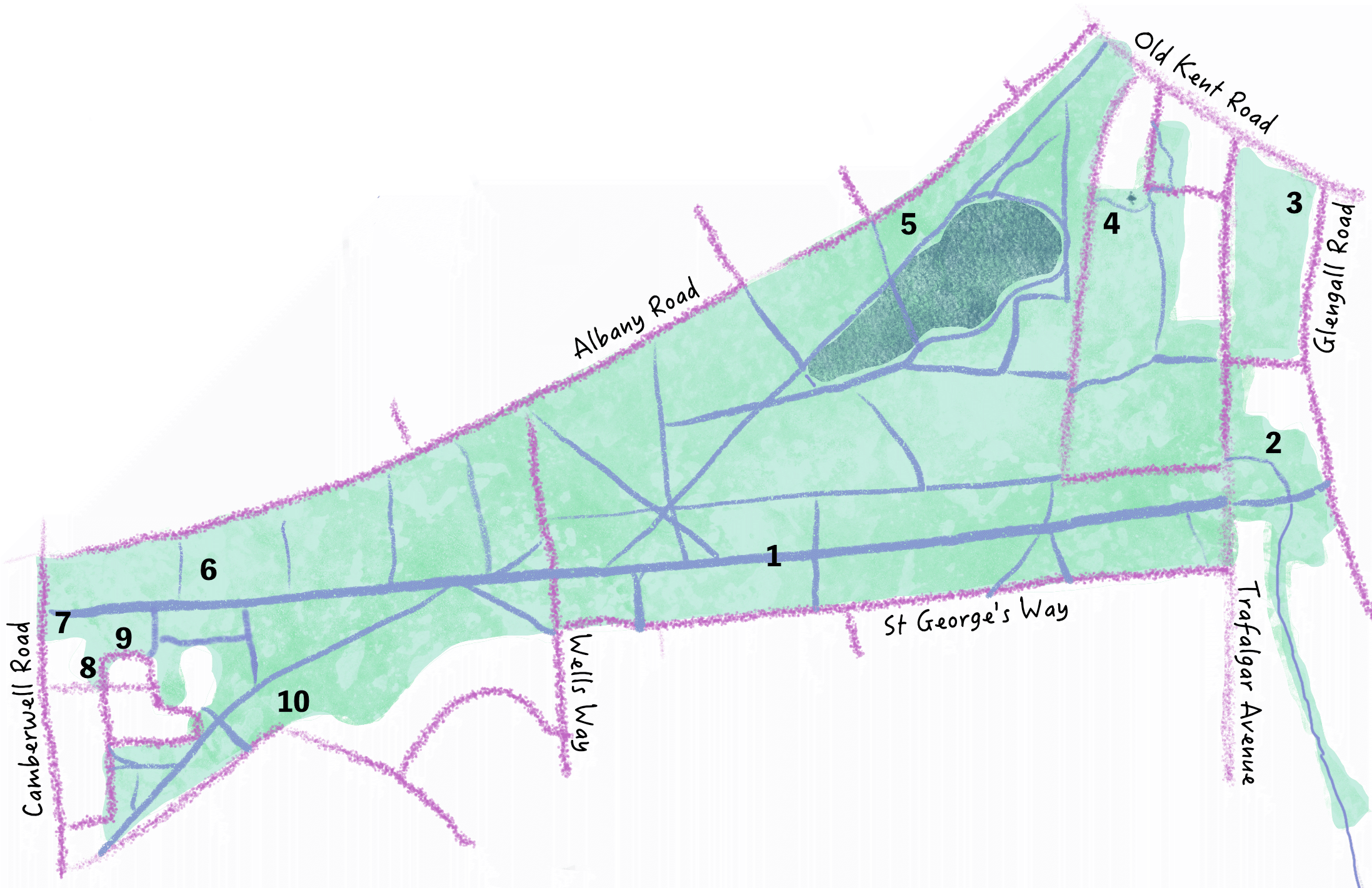
Location: see (1) on map above
Walkabout Two: Autumn 2025
Glengall Basin / Trafalgar Avenue (2) There should be a 30% reduction of scrub to improve visibility.
Glengall Road / Old Kent Road (3) This area is known as ‘Pursers’ by Parks Team.
Ideas for this area: Map or sign-posts to the rest of Burgess Park as it’s not clear that it leads into the park.
Remove asphalt from around tree roots to incorporate them into the park although pedestrians do use this area to get to the Old Kent Road bus stop.
Turn the fenced area into an orchard for heritage trees such as greengage and old apple varieties. However, viewing the large trees in this area benefits from the open space around them.
Cobourg nature area (4) used by First Place Nursery as a Forest School location
First Place don’t want any reduction of the undergrowth at present.
Improvements to the pond could be a volunteer project –
- Cover the exposed butyl liner with either pond underlay or stone-faced liner. This would protect the butyl pond liner, look better and provide traction for animals climbing out of the pond. It would be anchored in place with U shaped pegs.
- Surround the pond with pre-planted coir logs. The plants would provide protection for breeding pond invertebrates and amphibians and mask the pond liner. The logs would enable further planting of more unusual plants eg Epipactus palustris. (FOBP can supply this and Sagittaria sagittifolia). Ciaran can supply a waterlily and other pond plants. A suggestion includes retaining floating logs etc already in the pond for wildlife.
- Sink 2 or more plumber’s baths into the soil. One deep one close to the pond where children would be able to watch the development of frogspawn into tiny frogs. Amphibians roam around the landscape but like to rest in trays of water or mud, so additional, shallower baths around the site would benefit them and provide opportunities for the children to encounter frogs.
Albany Wood East section (5) The woodland floor is almost bare apart from ivy. A carpet of Dog’s Mercury (Mercurialis perennis) would normally cover an area like this and it would improve the soil structure absorbing and retaining more moisture. This would prepare the soil for more diverse plant cover.
Suggestions –
- Divert leaf litter from pavements to Albany Wood East to improve the soil. Ciaran (the head gardener) will spread leaf litter from the park here.
- Divide the area into say 10 coups for rotational coppicing. This creates 10 different habitats with different stages of growth. Some animals will prefer newly coppiced areas with new tree shoots others will seek out more mature trees for their nuts. The geese would probably explore the woodlands. Plants would flower in the newly cut areas where light levels would increase.
SUBSEQUENT THOUGHTS
Weed membrane – There’s lots of weed membrane in Albany Wood West. Is it in the eastern section too? Removal is essential for a diverse woodland flora. It would be a good opportunity to plant at the same time while the newly uncovered soil is bare.
Chestnut copse – We talked about the possibility of an orchard on the area to the south of Waite Street, I wonder if a stand of sweet chestnut trees was included, it could provide a useful supply of chestnut stakes for making hurdles or for hedge-laying in the park. We’d need a stand of hazel for the weavers too.
Walkabout Three: Spring 2026
Leave unmown areas on and around the mounds (6)
The un-mown areas support several species of grass eating butterflies. They spend winter feeding on grass stems. In order for them to complete their life cycle, it is important to leave some areas unmown throughout the year. These sites can rotate, but the new unmown zone should be adjacent to the old unmown zone. This also provides hibernation sites for insects that shelter in hollow stems and seeds for birds.
Recommended plants and grasses for the mounds to support these insects
Common rock rose Helianthemum mummularium, Doves foot Crane’sbill, Cow parsley, Wild marjoram, Oxeye daisy, Bramble, Mexican fleabane Erigeron karvinskianus, The thistle family including Knapweed, Downy oat grass, cocks foot, bromes and fescue grasses
It was agreed that FOBP could plant a native hedge here (7) to conceal the ugly fence and provide nesting spaces. To be planted 1 meter away from the fence. Focus on berries for birds and pussy willow to provide early pollen for bumble bees. FOBP to arrange for a volunteer session preparing the area with cardboard and woodchip mulch in September 2026 and arrange with Joseph Arrowsmith for whips. Also, arrange volunteer planting session once hedging whips arrive.
This area (8) looks empty but there are masses of violets. It was agreed that FOBP and volunteers could plant cowslips here once grown from seed. FOBP to arrange.
Part of the tennis court fencing (9) supports a splendid Clematis vitalba (Old Man’s Beard). FOBP encouraged Dom, the parks officer, to keep it in place as there are many house sparrow nests in its branches.
Better connections north/south for wildlife were discussed. An intermittent hedge of Gorse was suggested. Its dense, spiny growth provides good protection for wildlife.
As part of the planting for this site (10) which is at the beginning of the Southampton Way Nature Corridor leading down to Oliver Goldsmith School, FOBP suggested 3 native rose species: Rosa arvensis – white flowered field rose, Rosa rubignosa – Sweet briar as it has aromatic leaves as well as scented flowers and edible large hips and Rosa canina, the dog rose.